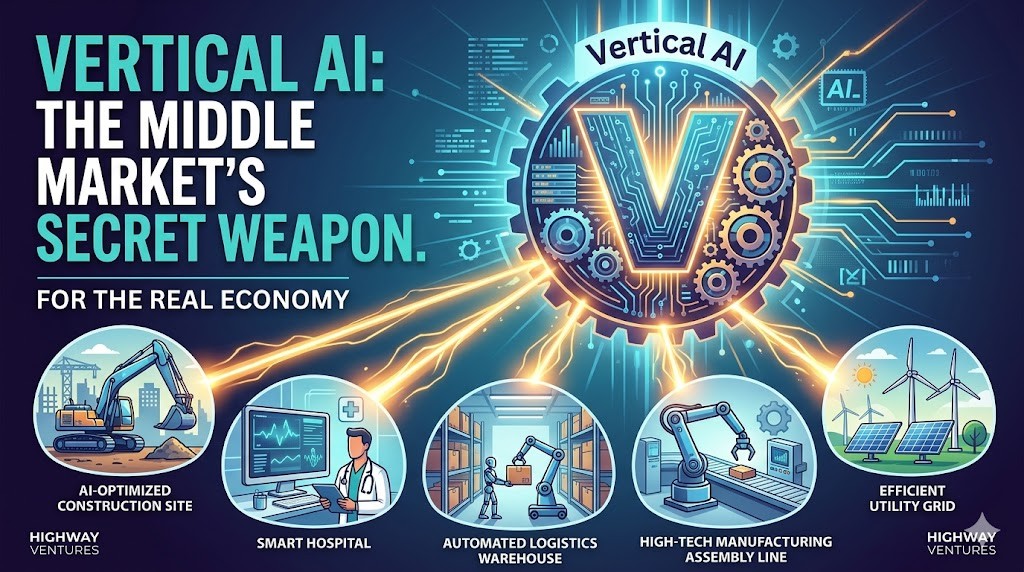
Beyond the Chatbot: Why Vertical AI is the Middle Market’s Secret Weapon
The honeymoon phase of "AI experimentation" is over. We’ve moved past the era of asking LLMs to write poems and entered the era of operational infrastructure.
For the last two years, the C-suite asked, "What can AI do?" Today, the question has shifted to: "How do we deploy this without breaking our existing systems?"
What’s becoming clear is that most companies don’t need another general-purpose "Copilot." They need systems that speak the language of their specific industry, respect their regulatory constraints, and slot directly into their existing workflows.
This is the era of Vertical AI.
The "Build vs. Buy" Decision
On paper, building an internal AI solution looks easy. Between open-source models (like Llama 3) and accessible APIs, many middle-market firms assume a small engineering team can "wrap" a model and call it a day.
The reality is a "hidden tax" that most companies aren't prepared to pay.
The Hidden Costs of Internal AI
Component | The "Build" Reality | The "Vertical AI" Solution |
Data Pipelines | Requires custom ETLs for legacy ERPs/CRMs. | Pre-built connectors for industry software. |
Maintenance | "Model drift" requires constant re-tuning. | Managed and updated by the vendor. |
Governance | Internal teams must invent audit trails. | Built-in compliance (SOC2, HIPAA, etc.). |
Time to Value | Typically 12–18 months. | Typically 3–6 months. |
As one operator put it: “What began as a weekend project quickly became a permanent infrastructure commitment.” For a regional hospital or a mid-sized logistics firm, the opportunity cost of pulling engineers away from core products to maintain "AI plumbing" is often a net negative.
The Middle-Market Sweet Spot
The most aggressive buyers in the Vertical AI ecosystem are the Middle-Market Backbone.
Think regional utilities, distributors, construction firms, and insurance administrators. These businesses share three traits:
High Complexity: They manage massive amounts of operational data.
Labor Scarcity: They struggle to find specialized talent to manage manual workflows.
Low Technical Overhead: They lack the 500-person engineering org needed to build custom LLM infrastructure.
Vertical AI vendors step into this gap by delivering systems designed around the specific friction points of a warehouse floor or a claims processing desk.
The Accountability Factor: Why Risk Matters
In regulated industries, "who is responsible?" is the most important question.
If an internally built AI makes a mistake in financial reporting or safety monitoring, the liability sits entirely on the internal IT team. By contrast, Vertical AI vendors build their entire business around accountability. The "Sleep at Night" Factor: Vertical AI isn't just about code; it’s about governance. These platforms come with audit logs, role-based access controls, and compliance frameworks that are battle-tested across dozens of similar customers.
Why Startups (Not Giants) Are Winning
You might expect Salesforce or Oracle to dominate this space. However, niche startups have a structural advantage: Radical Focus.
A horizontal software giant has to build features that work for everyone, which usually means they work perfectly for no one. A Vertical AI startup concentrates on solving one narrow problem, like automated sub-contractor billing or predictive maintenance for food cold-chains, extremely well.
The Power of the "Industry Network Effect"
As a Vertical AI vendor deploys across multiple companies in the same sector, they develop a "compounding knowledge" advantage:
They understand the specific quirks of industry data structures.
They anticipate regulatory shifts before they happen.
The product becomes smarter based on industry-wide patterns, not just one company’s siloed data.
The Bottom Line
Vertical AI is how the "Real Economy", the industries that move, build, and heal, finally captures the value of artificial intelligence.
For middle-market companies looking to modernize, the decision is becoming binary: You can spend two years trying to turn your IT department into an AI research lab, or you can partner with a specialized vendor who already knows your business.
At Highway Ventures, we believe the winners will be those who choose to buy the infrastructure and spend their energy on the execution.