Beyond the Agent Hype: Why the Most Successful AI Startups are Keeping Humans in the Loop
Understanding the Levels of Autonomy in Enterprise AI
Everyone is talking about autonomous AI agents. If you listen to the hype cycles in San Francisco, the "Self-Driving Enterprise" is six months away. The narrative is simple: replace human workflows with black-box agents that reason, plan, and execute.
But in the corridors of a Fortune 500 healthcare system or a municipal infrastructure department, that narrative isn't just visionary—it’s dangerous.
At Highway Ventures, we spend our time at the intersection of deep tech and legacy enterprise workflows. What we’ve learned is a hard truth for many AI founders: In the enterprise, customers don’t actually want full autonomy. They want control.
The tension isn't between innovation and stagnation; it’s between automation and accountability. When an AI agent makes a mistake in a creative brief, a marketing campaign underperforms. When an AI agent makes a mistake in patient safety routing, protein supply chain, or critical infrastructure operations, people get hurt and licenses get revoked.
To build a category-defining vertical AI company, you must stop selling "autonomy" and start selling "trust-weighted outcomes."
The Misconception: The "Agent" Fallacy
The prevailing Silicon Valley assumption is that the "Agent" is the end-state of software. Founders pitch systems that "act like an employee."
However, real-world buyer psychology is governed by Risk, Accountability, and Workflow Inertia. An enterprise buyer isn't looking for a "digital colleague" they can't fire when things go wrong. They are looking for a system that makes their existing team 10x more effective without increasing the surface area of organizational risk.
If you ship a "Full Autonomy" product on Day 1, you aren't providing value; you are providing a liability. The most successful AI companies won't be those that promise to take the human out of the loop, but those that design the most elegant way to keep the human in the loop.
Defining the Stack: AI-Powered Middleware vs. AI Agents
Before we discuss autonomy, we must distinguish between the two ways AI is entering the enterprise stack:
AI-Powered Middleware (Workflow Execution): This is the connective tissue. It’s software that uses LLMs to structure unstructured data, move it between silos (like Salesforce to ServiceNow), and ensure data integrity. It doesn't "decide" what to do; it "facilitates" the doing.
AI Agents (Decision-Making Systems): These are systems capable of reasoning. They take a high-level goal ("Resolve this ticket"), break it into steps, and execute them.
The mistake founders make is jumping straight to the Agent without building the Middleware. Without the workflow execution layer, an agent is just a brain without a nervous system.
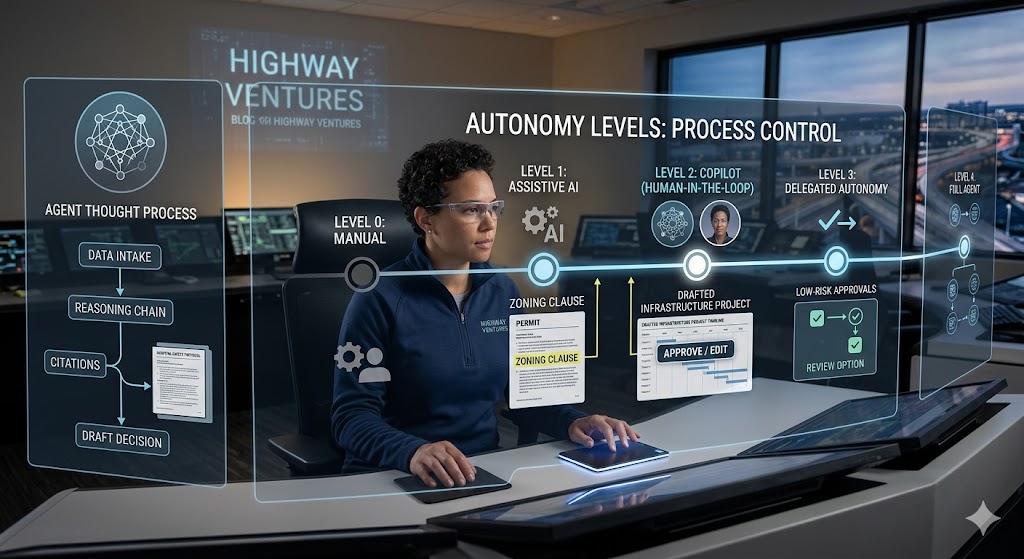
The Framework: The 5 Levels of Enterprise AI Autonomy
To navigate this, we are working to develop a framework for our founders. It defines how AI should be introduced into high-stakes environments.
Level 0: Manual
The status quo. Humans perform all data entry, analysis, and execution.
Example: A project manager manually reading a 200-page requirements document to check for compliance.
Level 1: Assistive AI (The "Highlighter")
The AI identifies and surfaces relevant information but makes no suggestions.
Example: An AI that flags missing fields in a healthcare IT ticket or highlights conflicting clauses in a construction contract.
When to use: Early-stage pilot programs to build data Moats.
Level 2: Copilot (The "Drafter")
The AI suggests an action or generates a draft, but the human must initiate the "send" or "approve" button. This is the Human-in-the-Loop standard.
Example: Drafting a response to a patient safety incident based on historical hospital protocols, waiting for a safety officer to edit and sign off.
Level 3: Delegated Autonomy (The "Reviewer")
The AI executes the task by default but provides a "Review Window" or "Kill Switch." It operates within strict guardrails.
Example: An infrastructure tool automatically validating standard residential construction plans that meet 100% of the criteria, while flagging only the anomalies for human review.
Level 4: Full Agent (The "Autonomous Operator")
The AI handles the entire lifecycle of a process from intake to completion with zero human intervention.
Example: A fully autonomous OT cybersecurity system that detects a breach and reconfigures network architecture in milliseconds.
When to use: Only when the cost of human latency exceeds the cost of an AI error (e.g., high-speed cyberattacks).
The Human Layer: Trust is Earned, Not Assumed
The "Human-in-the-Loop" (HITL) isn't a technical limitation; it’s a feature.
"The biggest winners in AI won’t be the most autonomous systems, they’ll be the ones that manage the human-AI boundary best."
In vertical AI, humans provide three things that LLMs cannot:
Accountability: A legal and professional "neck to wring."
Edge-Case Handling: The ability to navigate the "1% cases" that aren't in the training data.
Organizational Comfort: The psychological safety required for a department head to put their reputation on the line for your software.
Customers are looking for outcomes without losing control.
The Winning Strategy: A Roadmap for Founders
If you are building in Vertical AI, your Go-To-Market (GTM) strategy should be a "Salami Slice" approach to autonomy.
Sell Assistive, Build Toward Autonomy: Don't pitch the Level 4 future in the initial contract. Pitch the Level 1 and 2 efficiency gains.
Start with Workflow Augmentation: Map the existing workflow in ServiceNow, Epic, or Procore. Insert your AI into the gaps where humans are slowest (e.g., data synthesis).
Design for Transparency: Your UI should show the AI's "work." If an agent suggests a decision, it must cite the source document.
The "Shadow Mode" Launch: Run your autonomous logic in the background of your copilot. Show the user: "The AI would have made this decision correctly 99% of the time last month." That is how you move a customer from Level 2 to Level 3.
The Contrarian Take: Autonomy is a Liability
Here is the inconvenient truth: Agent-first products without trust layers will lose to workflow-first products that evolve.
Many "Agent" startups are building cool tech in search of a problem. They focus on the complexity of the reasoning chain. But the enterprise buyer doesn't care how many "thought loops" your agent took. They care about who is responsible when the system fails.
If you build a product where the human feels "out of the loop," you have created a product that will be uninstalled the moment the first hallucination occurs.
Closing: Earning the Right to Automate
Autonomy is not a feature you ship on a Friday afternoon. It is a capability you earn through months of consistent, high-fidelity performance in the "Copilot" phase.
The goal for the next generation of enterprise AI founders isn't to build a system that replaces the human. It's to build a system so reliable, so transparent, and so integrated into the workflow that the human chooses to let go of the steering wheel.
Autonomy isn’t a feature you ship, it’s a capability you earn.